Blockchain has been touted as the solution to many of the challenges in carbon markets: double-counting, lack of transparency, and fragmented registries. Advocates argue that a distributed ledger could make carbon credits tamper-proof, transparent, and tradable across borders.
But as with any emerging technology, blockchain has also attracted skepticism. Critics worry about hype, energy use, and whether blockchain alone can solve problems that are as much about governance as they are about data.
So where does the truth lie? This article explores the role of blockchain in carbon registries—cutting through the hype to highlight real opportunities, limitations, and the path forward.
1. Why Blockchain Appeals to Carbon Markets
Carbon markets face credibility challenges:
Double Counting: The same credit being sold or claimed multiple times.
Opacity: Limited transparency around issuance, transfer, and retirement.
Fragmentation: Multiple registries with inconsistent rules.
Verification Costs: High transaction costs for validating credits.
Blockchain offers potential solutions:
Immutable Ledgers: Once recorded, credits cannot be altered or duplicated.
Transparency: Public, auditable records of issuance and retirement.
Interoperability: Ability to link multiple registries into a shared infrastructure.
Automation: Smart contracts could streamline credit issuance, trading, and retirement
2. How Blockchain is Being Applied in Carbon Registries
a)Tokenization of Carbon Credits
Credits are digitized into blockchain-based tokens that can be traded across platforms. This improves liquidity and opens up new financial products.
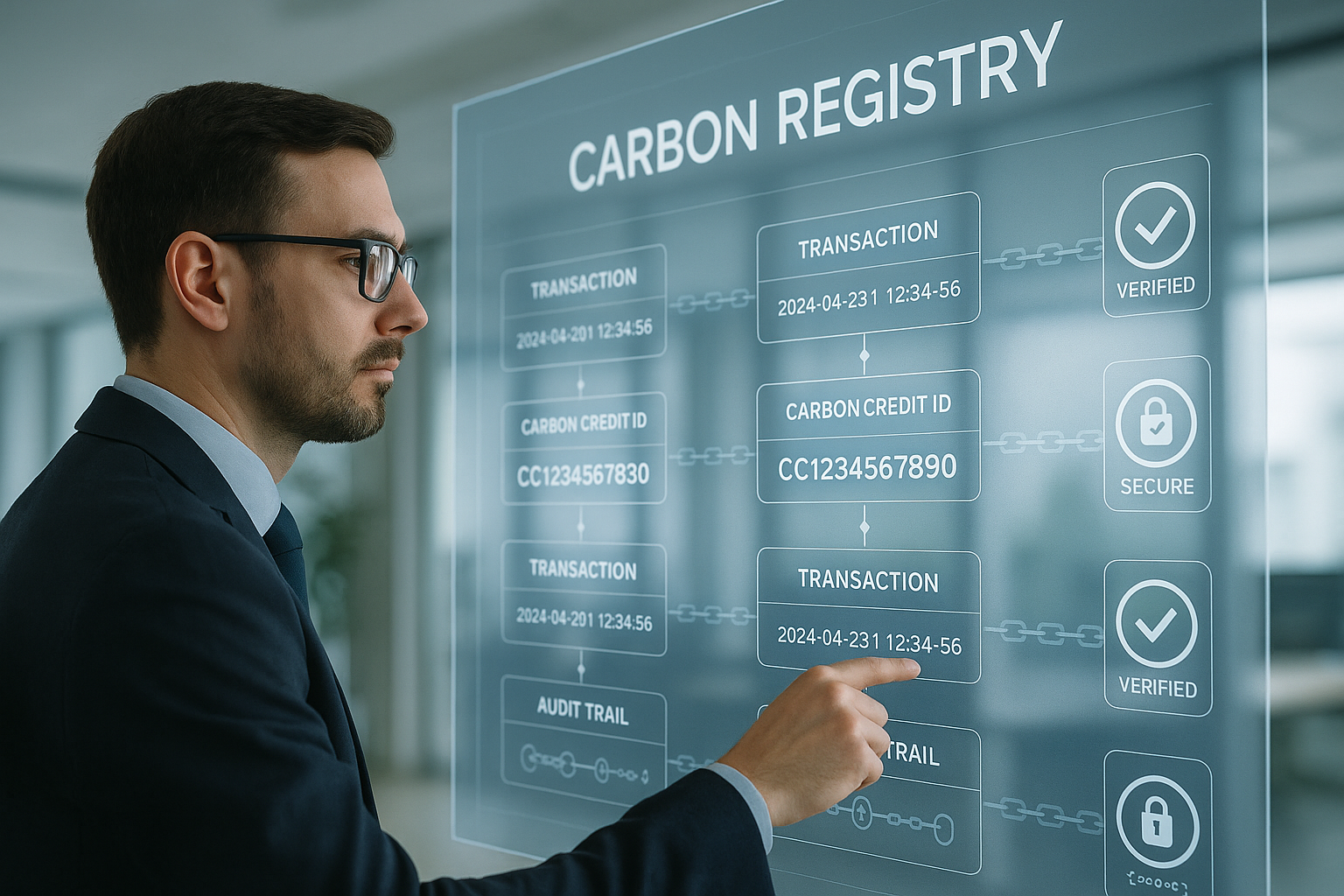
Blockchain-based registries create open ledgers where issuance, transfer, and retirement are visible to all participants.
Example: AirCarbon Exchange uses blockchain to track carbon credit trades with full transparency.
c)Integration with MRV Data
Blockchain can integrate directly with remote sensing, IoT sensors, and AI-driven MRV tools to record verified emissions reductions in real time.
Example: Regen Network links satellite and sensor data with blockchain to validate nature-based credits.
3. Benefits of Blockchain in Carbon Registries
Trust Through Transparency: Buyers can see exactly when and how a credit was issued and retired.
Fraud Prevention: Immutable records reduce the risk of double issuance or manipulation.
Efficiency: Smart contracts reduce administrative burdens in credit transfers.
Liquidity: Tokenized credits can be traded globally, opening up secondary markets.
Accessibility: Blockchain platforms can democratize participation by lowering barriers for smaller developers and buyers.
4. Challenges and Criticisms
a)Energy Use
Ironically, some blockchains consume vast amounts of energy. This is especially problematic for markets meant to reduce emissions. (Though newer blockchains using proof-of-stake are far less energy-intensive.
b)Regulatory Acceptance
Governments and compliance markets are cautious about blockchain-based credits, questioning whether they align with Article 6 rules.
c)Risk of “Digital Greenwashing”
Tokenization alone does not guarantee quality. If low-integrity credits are tokenized, blockchain simply scales a bad product faster.
d)Market Fragmentation
Dozens of blockchain-based carbon platforms have emerged, creating confusion rather than clarity. Interoperability is still limited.
e)User Trust
Blockchain is still associated with volatility, speculation, and fraud from the crypto sector—risks that carbon markets cannot afford.
5. Case Studies
Toucan Protocol: Enabled the tokenization of millions of voluntary credits but faced criticism when low-quality credits flooded the system.
Regen Network: Focuses on nature-based solutions with blockchain-based MRV integration, offering a model of quality-first digitization.
AirCarbon Exchange (Singapore): A regulated exchange using blockchain for credit trading, demonstrating regulatory pathways forward.
Verra & Gold Standard: Both major registries are exploring blockchain integrations, though cautiously, emphasizing governance as much as technology.
6. The Future: Beyond the Hype
Blockchain alone cannot solve integrity challenges—but combined with robust governance and MRV, it can play a pivotal role.
What’s Next:
Hybrid Models: Traditional registries adopting blockchain backbones for transparency while retaining oversight.
Integration with Article 6: Blockchain systems aligning with corresponding adjustment requirements to ensure Paris Agreement compliance.
Digital MRV + Blockchain: Combining AI, IoT, and blockchain to create real-time, tamper-proof climate ledgers.
7. Best Practices for Registries Considering Blockchain
Focus on Integrity First: Technology should enhance, not replace, rigorous credit quality checks.
Choose Energy-Efficient Blockchains: Proof-of-stake or other low-carbon consensus mechanisms.
Ensure Interoperability: Build systems that can connect across registries and compliance markets.
Educate Buyers: Provide transparency not only in transactions but also in project methodologies.
Engage Regulators Early: Ensure blockchain solutions align with Article 6 and national policies.
Conclusion
Blockchain is not a silver bullet for carbon markets, but it is a powerful tool when applied responsibly. It can make registries more transparent, efficient, and accessible—if paired with strong governance and quality standards.
The hype has often overstated what blockchain can do, but the reality is still compelling: blockchain can help carbon registries evolve into digital, trusted, and globally interoperable infrastructure for climate action.
The takeaway: Blockchain will not replace registries—it will reinvent them.