Green Mines

Closing the Trust Gap in Carbon Markets

Executive Summary

Carbon markets cannot scale without trust. High-profile critiques, inconsistent methodologies, and opaque governance have created a trust gap between what credits promise and what stakeholders believe. This article maps the root causes of that gap and presents a pragmatic playbook—spanning data integrity, transparency, governance, and accountability—for registries, developers, buyers, and auditors to close it. The destination: a market where every credit is traceable, defensible, and durable.

1) What Is the “Trust Gap”—and Why It Matters

The trust gap is the delta between the claimed climate benefit of a carbon credit and the confidence stakeholders have in that claim. It shows up as:

  • Buyer hesitation (paused purchases, stricter screens).
  • Media scrutiny (questioning additionality and permanence).
  • Regulatory pressure (alignment with Article 6, consumer-claim rules).
  • Capital bottlenecks (institutional investors waiting for integrity signals).

Left unaddressed, the trust gap drives a “race to the bottom” on price and quality. Closed properly, it unlocks scale, liquidity, and finance.

2) Root Causes of the Trust Gap

  1. Data and Methodology Issues
    1. Over-optimistic baselines; weak leakage accounting; sporadic MRV.
  2. Opacity and Fragmentation
    1. Non-public documents; incompatible registries; limited cross-checks.
  3. Permanence & Reversal Risk
    1. Fires, pests, policy shifts; thin buffers; slow remediation.
  4. Governance Weakness
    1. Conflicts of interest; non-standard audits; unclear dispute processes.
  5. Claims & Communication Risks
    1. Vague marketing; inconsistent terminology (avoidance vs. removals).

3) Four Pillars to Close the Gap

Pillar A — Data Integrity by Design

  • Conservative baselines with uncertainty bands and version-controlled assumptions.
  • Digital MRV (dMRV): integrate satellite, IoT, meter data; automate anomaly flags.
  • Mandatory ground-truthing cadence (e.g., risk-weighted, not calendar-fixed).
  • Cross-dataset triangulation (e.g., SAR + optical + field plots).
  • Immutable provenance: cryptographic signatures on raw datasets and model outputs.

Operational KPI ideas

  • % of credits backed by machine-readable MRV feeds
  • Median time from event (fire/logging) to registry flag
  • Share of projects with quantified uncertainty and correction factors

Pillar B — Radical Transparency

  • Open project files (methodology, baseline, MRV plans, verification reports).
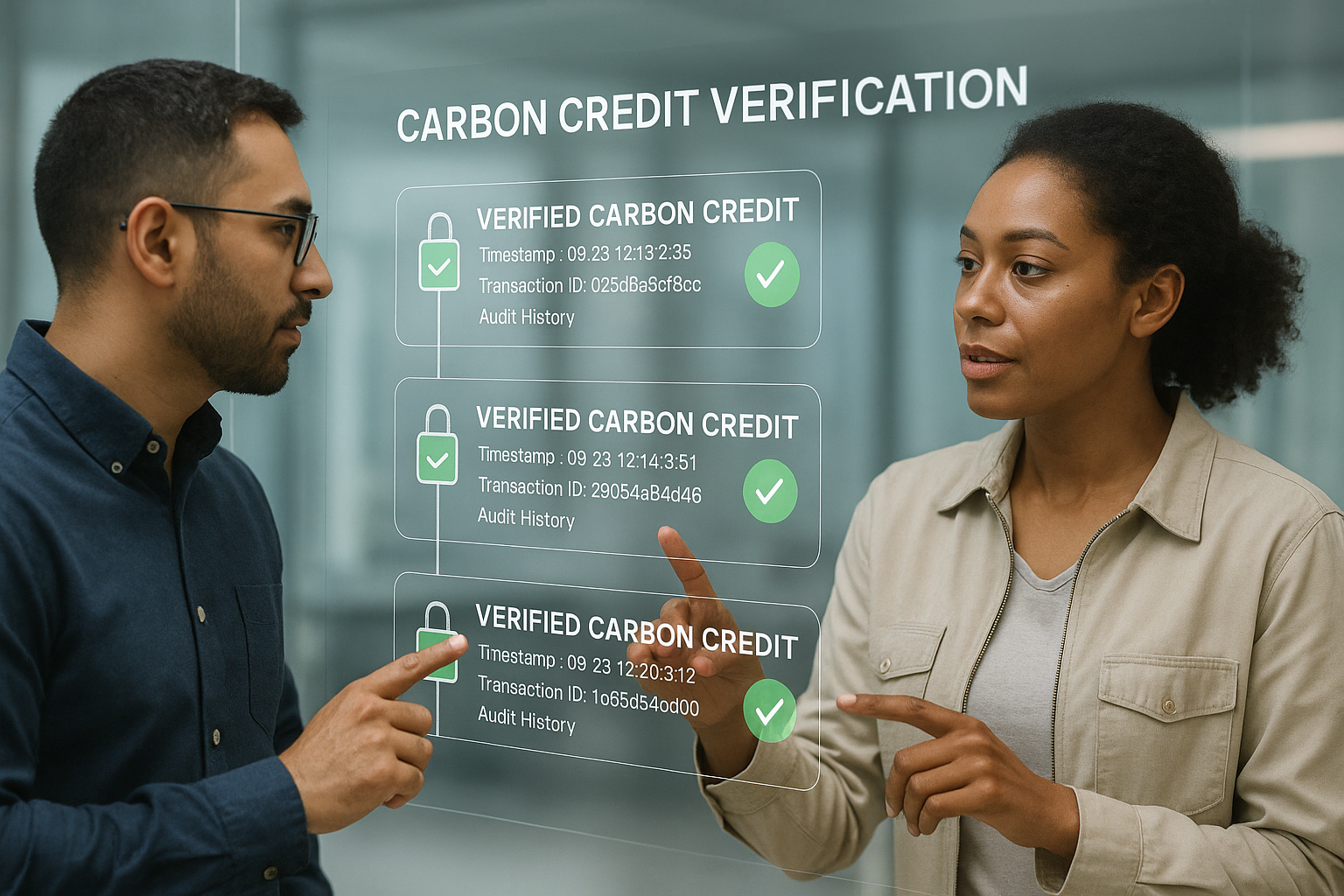
  • Explorable credit lifecycle: issuance → transfers → retirement on a public ledger.
  • Labeling taxonomy: avoidance vs. removals; NbS vs. tech-based; Article-6-aligned (Y/N); buffer contribution; permanence horizon.
  • APIs for third-party analytics; downloadable CSV/Parquet datasets.
  • Disclosure of co-benefits evidence (biodiversity, livelihoods) with data quality grades.

Transparency KPI ideas

  • Data completeness score per project
  • Average document latency (days from verification to public posting)
  • % of retirements linked to public corporate claims pages

Pillar C — Robust Governance & Independent Oversight

  • Verifier accreditation with rotation rules and conflict-of-interest checks.
  • Appeals & grievances process with SLA (e.g., 30/60/90-day tiers).
  • Risk committees (science, social safeguards, cybersecurity).
  • Methodology lifecycle management: proposal → sandbox pilots → public comment → adoption → scheduled review.
  • Whistleblower channels with protections and transparent case logs.

Governance KPI ideas

  • Average time to resolve grievances & % resolved within SLA
  • % of methodologies reviewed on schedule
  • Verifier rotation rate and independence score

Pillar D — Accountability & Risk Management

  • Dynamic buffer pools sized by modeled reversal risk (climate, biotic, socio-political).
  • Reversal response playbooks: automatic cancellation from buffers; replenishment rules; event forensics.
  • Corresponding adjustments pathways for Paris alignment where applicable.
  • Remediation & benefit-sharing policies with pre-funded reserves for communities.
  • Audit trails: reproducible pipelines; re-verifications triggered by risk events.

Accountability KPI ideas

  • Buffer sufficiency ratio under stress scenarios
  • Time to detect & settle reversals
  • % of portfolio with Article-6-ready documentation

4) The Registry Playbook (Actionable, Step-by-Step)

Step 1 — Publish a Quality Manifesto

  • Commit to conservative accounting, open data, and standardized labels.
  • Map alignment with ICVCM/VCMI principles and Article 6 concepts in plain language.

Step 2 — Ship a Public Data Portal

  • Project dashboards with: baseline versions, MRV streams, verifier reports, buffer status, transfer/retirement graph, grievance log.
  • Bulk download + API; human-readable summaries and machine-readable schemas.

Step 3 — Implement dMRV Pipelines

  • Ingest: satellite (optical/SAR), lidar where relevant, IoT/meter data.
  • Rules engine: anomaly detection (deforestation alerts, energy under-performance).
  • Human-in-the-loop workflow for validation and corrective actions.

Step 4 — Risk-Weighted Oversight

  • Higher-risk projects (e.g., fire-prone forests) → tighter audit cadence, bigger buffers.
  • Lower-risk (e.g., geologic storage) → lighter buffers but strict metrology.

Step 5 — Open Methodology Lab

  • Host pilot “sandboxes” for new methods with transparent results.
  • Time-boxed public comment, red-team reviews, and versioned releases.

Step 6 — Claims Integrity Toolkit for Buyers

  • Retirement certificates with QR-linked proofs (data, methodology, CA status).
  • Standardized language templates for marketing & ESG reports to avoid overclaiming.

Step 7 — Community & Safeguards

  • Free, multilingual summaries for local stakeholders.
  • Consent logs; revenue-sharing disclosures; independent grievance redressal.

5) Developer Checklist (Build for Credibility)

  • Evidence-ready baselines with counterfactual options tested and archived.
  • Field protocols: photo/video geotagging, randomized plot selection, digital chain-of-custody.
  • Permanence plan: firebreaks, insurance, community compacts, adaptive management.
  • Co-benefits monitoring with simple, repeatable indicators (e.g., water quality, livelihood metrics).
  • Data escrow so verifiers/registries can re-run computations on demand.

6) Buyer Checklist (Procure with Confidence)

  • Demand labeled credits (removal vs. avoidance; NbS vs. tech; Article-6-aligned?).
  • Review MRV completeness and uncertainty; look for anomaly flags & corrective logs.
  • Check buffer size & rules; understand reversal coverage.
  • Retire with public proofs and precise claims language (no “carbon neutral” if out of scope).
  • Diversify into hybrid portfolios to balance cost, permanence, and co-benefits.

7) Auditor & Verifier Upgrades

  • Standards harmonization playbook; shared checklists and scoring rubrics.
  • Data-first audits: reproduce model outputs; challenge baselines using external datasets.
  • Continuous assurance models (lighter, more frequent digital checks + periodic deep dives).
  • Transparency reports: publish non-confidential findings and common error patterns.

8) Metrics That Move Markets (A Compact Scorecard)

Dimension

Lead Indicator

Target Idea

Data Integrity

% credits with live dMRV feeds

>80%

Transparency

Document latency (days)

<7

Permanence

Modeled buffer sufficiency (P95)

≥1.2x risk

Accountability

Reversal settlement time

<30 days

Governance

On-time methodology reviews

>95%

Community

Grievance closure within SLA

>90%


Use these as north stars; publish quarterly.

9) Communications: Turning Proof into Trust

  • Plain-English project pages with “What we know / What we’re still validating.”
  • Change logs for methodologies and baselines (like product release notes).
  • Independent voices: invite third-party analyses and link them—favorable or not.
  • Crisis playbooks for reversals: acknowledge, act, audit, adapt—publicly.

Create your account