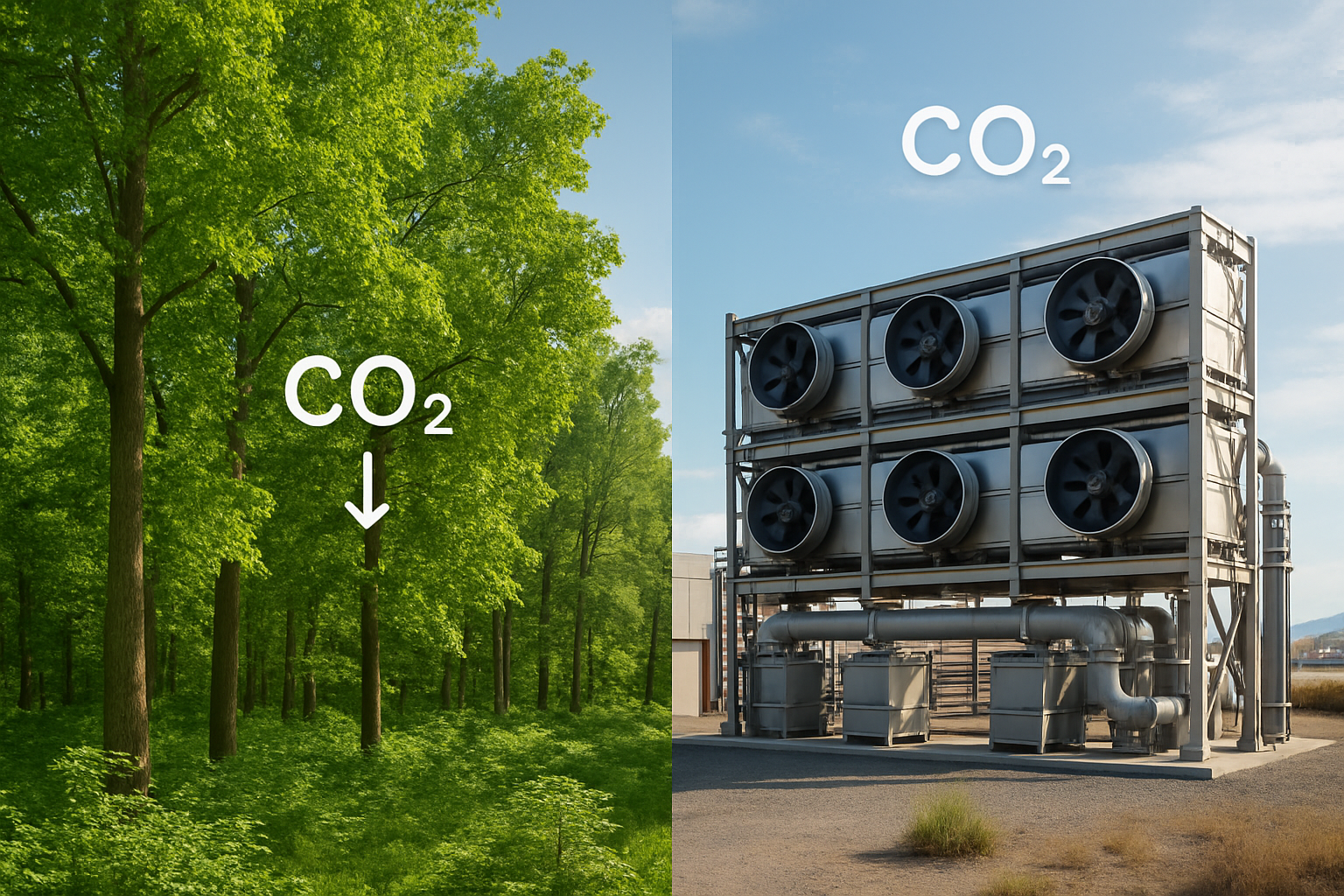
Nature vs. Machines: The Evolving Debate in Carbon Removal
Introduction
As the world races toward net zero, one of the most important debates in climate action is how best to remove carbon dioxide from the atmosphere. Should we rely primarily on nature-based solutions (NbS) like reforestation, soil carbon sequestration, and mangrove restoration? Or should we invest in technology-based solutions (TbS) such as direct air capture (DAC), bioenergy with carbon capture and storage (BECCS), and mineralization?
Both approaches offer promise—and both have limitations. The debate is not simply one of preference, but of scale, permanence, cost, and co-benefits. This article explores the evolving discussion between “nature vs. machines,” why the market needs both, and how registries can help ensure credibility across approaches.
1. Nature-Based Solutions: The Old but Essential Tool
What they are Projects that protect or enhance ecosystems’ ability to store carbon: reforestation, avoided deforestation, mangrove and peatland restoration, and soil carbon practices.
Case example Large-scale forest conservation (e.g., the Amazon Fund) shows how NbS can deliver carbon and co-benefits at scale — while remaining exposed to policy and economic shifts.
Mini takeaway Nature is your fastest lever for near-term, lower-cost tonnes — but it needs robust MRV, risk buffers, and long-term stewardship.
2. Technology-Based Solutions: The Emerging Frontier
What They Are
Technological removals include DAC (machines capturing CO₂ directly from the air), BECCS (biomass energy with capture and storage), enhanced weathering, and ocean alkalinity enhancement.
Advantages
Permanence: CO₂ stored underground or mineralized can remain locked away for centuries to millennia.
Precision: Easier to measure and verify than diffuse natural systems.
Scalability (long term): Potential to remove gigatons annually if costs fall.
Compatibility with Industry: Fits within industrial infrastructure and supply chains.
Limitations
High Cost: DAC currently ranges from $400–$600 per ton.
Energy Intensive: Requires significant renewable energy deployment.
Social Acceptance: Concerns about “techno-fixes” distracting from emissions reductions.
Early Stage: Many technologies are not yet proven at scale.
Case Example: Climeworks in Iceland operates one of the first commercial DAC plants, storing captured CO₂ in basalt rock through mineralization.
3. Why the Debate Exists
Philosophical Divide: Conservationists emphasize working with nature; technologists stress engineered certainty.
Funding Competition: Limited climate finance raises questions about which solutions deserve priority.
Policy Uncertainty: Governments have been quicker to support NbS but are now beginning to incentivize TbS through tax credits (e.g., U.S. Inflation Reduction Act).
Buyer Preferences: Some corporates prefer low-cost, nature-rich credits; others want permanence and risk insurance.
4. The Case for Nature + Machines (Hybrid Portfolios)
Rather than an either/or debate, leading experts argue that both approaches are essential.
Short to Medium Term: Nature-based solutions provide immediate, affordable carbon removal at scale.
Long Term: Technology-based solutions offer durable, high-certainty storage once costs fall.
Resilience: A diversified portfolio reduces reliance on any single solution and spreads risk.
Example: A corporate buyer might invest in regenerative agriculture (NbS) to deliver near-term reductions while purchasing DAC credits (TbS) for hard-to-abate residual emissions.
5. The Role of Registries in Balancing the Debate
Registries will play a key role in ensuring credibility across both solution types:
Standardizing MRV: Developing methodologies that fairly account for both NbS uncertainty and TbS precision.
Risk Management: Creating buffer pools and permanence insurance mechanisms for NbS.
Transparency: Clear labeling of credit types (e.g., avoidance vs. removals, NbS vs. TbS) to help buyers make informed choices.
Market Integration: Enabling hybrid portfolios that combine nature and technology credits under unified accounting systems.
6. The Path Forward
By 2030, the debate may shift from “nature vs. machines” to “how do we optimize the mix?”. Expect:
Price Differentiation: NbS credits remain cheaper but rise in value with added co-benefits; TbS credits command premiums for permanence.
Policy Integration: Governments incentivize both, with NbS supporting adaptation/resilience and TbS delivering durable removals.
Investor Engagement: Hybrid funds that pool both NbS and TbS projects for diversified exposure.
Corporate Disclosure: Net zero strategies requiring clarity on which balance of NbS/TbS is used.
Conclusion
The climate crisis is too urgent for binary choices. Nature-based and technology-based carbon removal are not competitors—they are complements. One provides scale and co-benefits today, the other delivers permanence and precision tomorrow.
The smartest climate strategies, and the most forward-thinking carbon registries, will recognize that the path to net zero lies in leveraging the best of both worlds.
The takeaway: It’s not nature versus machines. It’s nature and machines—working together for a stable climate future.